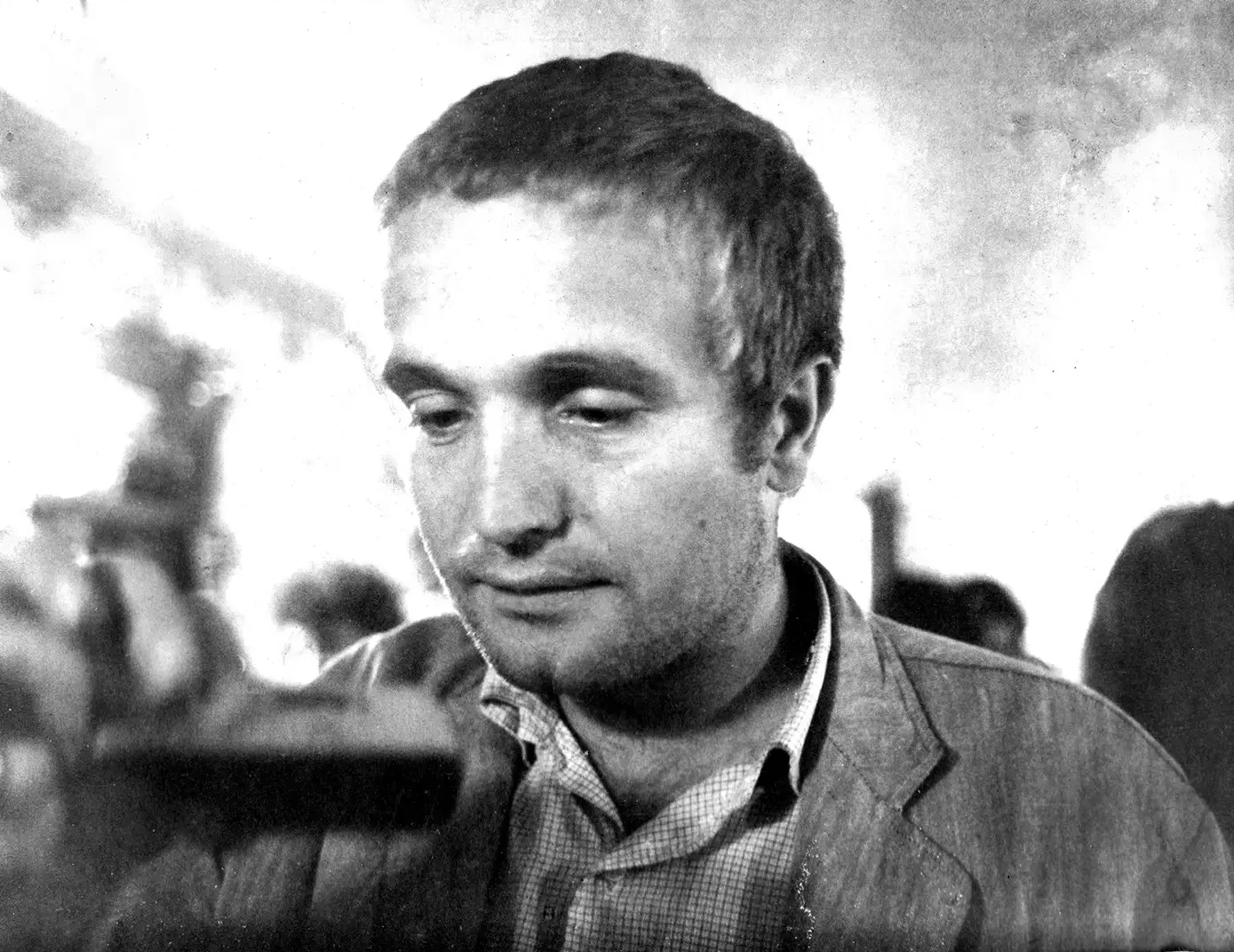
Roy Noakes dedicated his life to evolving an alternative sculptural language, one concerned with transience and lightness, to conveying fleeting appearances and gestures with the greatest economy of means, pared down, that is, in the sense of needing to eliminate everything that was extraneous to the inner energy of his forms. He worked, in short, outside all of the mainstream or avant-garde cultural orthodoxies of his time, neither a Brutalist, a conceptualist, nor involved with smooth or shiny surfaces that were barriers to expressing the dynamic potential of his materials.
Martin Harrison
Roy Noakes
1936-2002
A Language Beyond Words
Roy Noakes never wrote about his work, although he was known to parry queries about his aims with quotes from artists he admired, offering clues to his thinking:
‘Sculpture is not an outside sport’
Edgar Degas
‘The language of sculpture is dead’
Arturo Martini
He did, however, scribe on the wall of his Cambridge studio:
‘I am working on a language that is a language of its own: it doesn’t translate into words’.
Early Life and Apprenticeship
Noakes was born in 1936 in the Peabody Buildings, Stepney, East London, the youngest of five children. His father, who painted white lines along Commercial Road and who, by account, made a great copy of Frans Hals ‘ Laughing Cavalier’, encouraged him to draw and paint.
At fifteen, Noakes was apprenticed to the monumental masons Anselm Odlings &Co Ltd, where he learned to use a pointing machine and, crucially, to free carve angels under Italian master carvers.
He later transferred to Gerald Giudici, working on public monuments and architectural reliefs designed by leading sculptors including Sir Charles Wheeler CBE PRA, Gilbert Ledward OBE RA , James Woodford OBE RA and David McFall. During this time, he formed a lifelong friendship with James Butler, who encouraged him to attend drawing classes.
Training and Influences
After National Service and with support from the Goldsmiths Company, Noakes studied at the City and Guilds Institute. There, Bernard Sindall introduced him to both Classical and Renaissance sculpture, as well as contemporary European artists such as Giacomo Manzù, Arturo Martini and Medardo Rosso.
The Beckwith Scholarship from the Worshipful Company of Fishmongers enabled him to travel to Italy. This experience, alongside the 1964 Giacomo Manzù exhibition at Tate Britain and the Pompeii figures revealed by Giuseppe Fiorelli and Amedeo Maiuri, accelerated his development as a figurative sculptor.
Developing a Figurative Language
As a student, Noakes produced a series of imagined freestanding figures. Rather than following strict anatomical muscular accuracy, he used the freedom that modelling in clay presented, to create figurative structures that conveyed dynamic movement and emotion.
A Shifting Artistic Landscape
In post-war Britain, sculpture moved away from large Victorian and Edwardian workshops. The rise of art schools and municipal and private art galleries encouraged younger artists to pursue personal philosophies.
Great Sampford: Expansion and Experimentation
Noakes moved to Great Sampford, North-East Essex, where he built a studio and began a more experimental body of work. While still rooted loosely in the human form, his sculptures grew in scale and simplicity, using stone, resin and fibreglass.
His focus shifted towards the relationship between overall form, the silhouette and the internal structures, exploring how a sculpture is often experienced from multiple viewpoints rather than for the complexity of the internal forms.
Creative Exchanges and Portraits
Though he worked alone, conversations with composer Alan Rawsthorne, painter Isabel Rawsthorne and writer Jack Lindsay—often in the Black Bull—helped shape his thinking.
He made portraits of each of them.
Cambridge: Constraint and Clarity
In the early 1970s, Noakes moved with his family to Cambridge. Working in a confined ground-floor space, the limitations of light and scale led him to abandon large armatures and rethink his creative process. Modelling more directly in high and low relief on wooden boards, he reduced the form from the mass with a carver’s approach. This shift brought greater immediacy and clarity to his work, and his ideas about sculpture became more defined.
Influence of Medardo Rosso
This approach echoes Medardo Rosso’s belief in the unity of artistic disciplines. In 1896 he wrote:
‘Painting? Sculpture? there is only one art, identical and indivisible at all times… within every great painter there lies a great sculptor.’
Yorkshire: Landscape and Light
In the early 1980s, Noakes moved to North Yorkshire. Walking in the landscape, he concentrated on how light alters the perception of form, reinforcing his interest in how static objects can appear to shift through changing light conditions.
Relief Work and Light
Returning to low relief, he explored the effects of natural, distorted and artificial light in a final series of works depicting swimmers and interiors.
Process and Drawing
Noakes made few preparatory drawings. He left numerous more spontaneous chalk drawings after a sculpture was completed.
Portraiture
Throughout his career Noakes created portraits – both commissioned and of family, and friends.
Bronze casting
Noakes used three different foundries: Fiorini and Carney, Mike Davies and Black Isle Bronze. He stipulated that there should be only three bronze casts of any one work
Roy Noakes Exhibitions
1964 Gt. Sampford Essex. Catalogue with Adam Woolfit photographs
1968 Gt. Sampford Essex
1971 Geoffrey Archer Gallery. Catalogue written by Jack Lindsay
1975 Sculpture in Holland Park Exhibition
1985 Arcade Gallery Harrogate
1988 October Gallery London catalogue written by David Thompson
1989 ‘Portraits’. Mercer Gallery Harrogate
2009 Retrospective. number 3 Studio Gallery. Catalogue written by Martin Harrison
2010 Noakes and Rawsthorne ‘Lovers and Friends’ at number 6 Studio Gallery
2023 ‘Loosing the silhouette’ Sculpture and Paper Works. number 6 Studio Gallery
Works in public National Collections
Arts Council: work currently in Peterborough Art Gallery Collection
National Portrait Gallery
Walsall New Gallery
North Yorkshire County Council
The Mercer Gallery Harrogate
NHS Scarborough Hospital
Parliament- House of Commons
Parliament- Foreign Office
Northampton Council
Royal Northern College of Music